If your business answers customers on WhatsApp through the official API — with an AI assistant, a support team, a CRM, or all three — the way Meta bills those answers changed on 1 October 2026. Nothing in your chats stops working. But a number that used to be free now has a price after a monthly allowance, and it is worth understanding it before the first invoice, not after.
In short
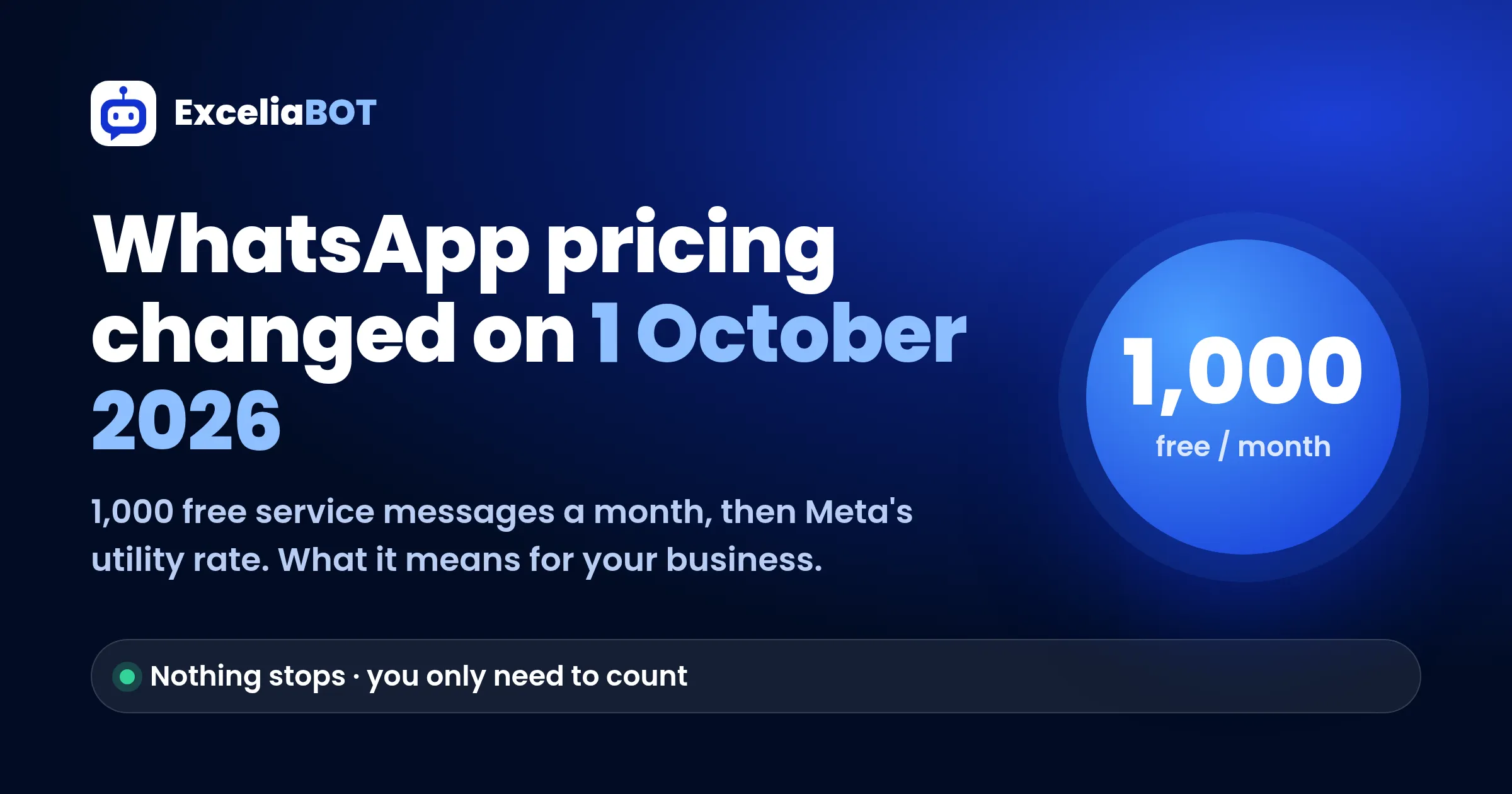
- From 1 October 2026, every free-form reply a business sends on WhatsApp inside the 24-hour window is a service message; each business number gets 1,000 free per calendar month.
- From the 1,001st, Meta charges its utility rate for the customer's country (Egypt: about $0.0036 + VAT) on the business's own Meta account. Nothing stops.
- Templates, replies typed in the phone app, ad-conversation free windows and undelivered messages are not counted.
- In September 2026 the busiest number on ExceliaBOT sent 692 service messages; no account would have paid.
What changed
Since November 2024, replies sent inside the 24-hour customer service window — the day that opens every time a customer writes to you — were free, without limit. Meta called them service conversations.
From 1 October 2026 those replies are called service messages and are counted one by one:
- Every business phone number gets 1,000 free service messages per calendar month. The allowance resets on the 1st and unused messages do not carry over.
- From message 1,001, Meta charges each one at the utility rate of the customer's country — the same rate it charges for an order-confirmation template.
- Utility templates sent inside the window, which used to be free there, are now billed at the utility rate as well, from the first one.
- The 72-hour free window that opens when a chat starts from a click-to-WhatsApp ad stays free, service messages included.
The charge lands on your own Meta account, exactly like template messages do today. A platform like ExceliaBOT is not in the middle of that money — and adds nothing to it.
What counts, and what does not
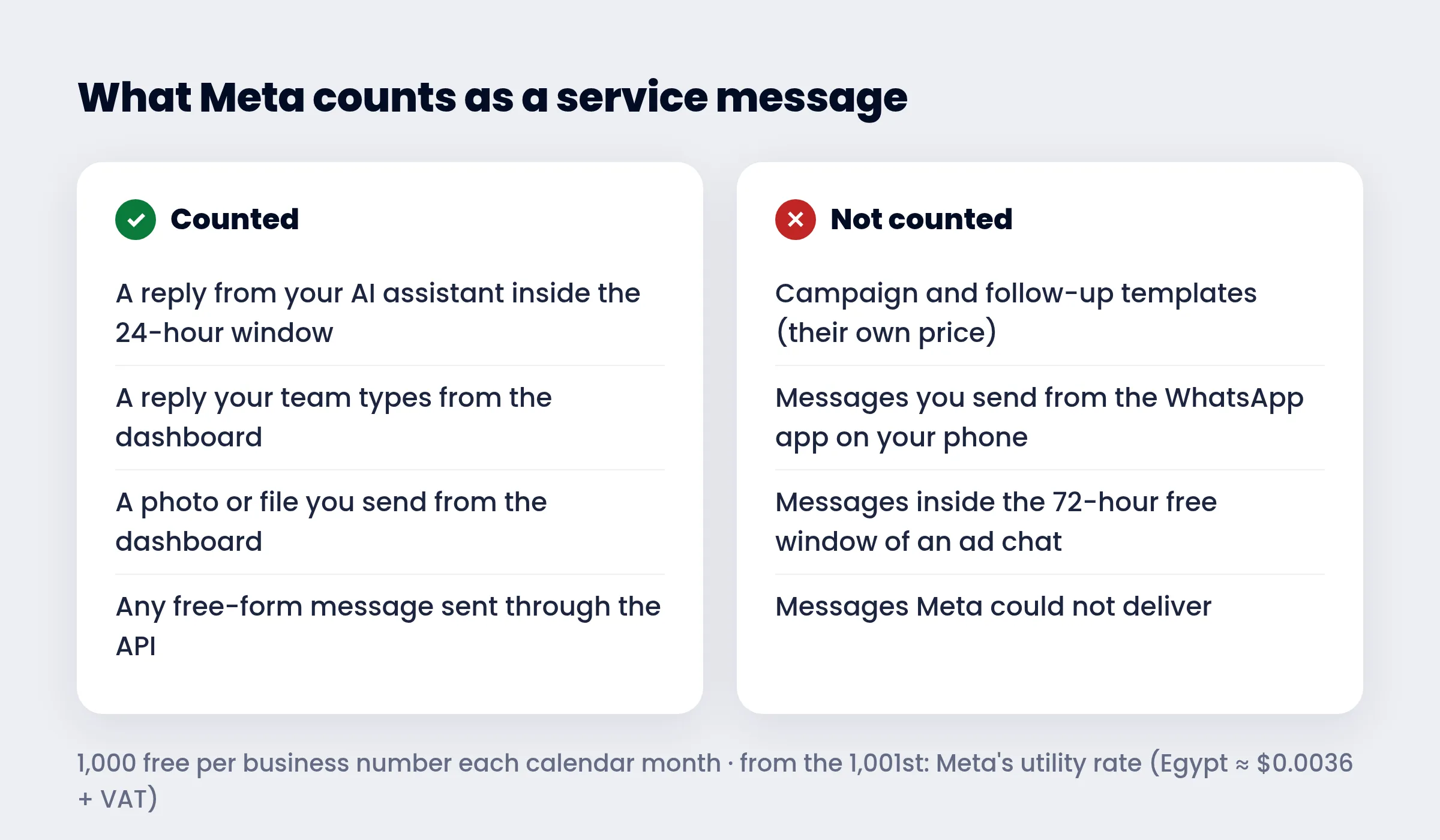
A service message is any free-form message your number sends through the API while the customer's 24-hour window is open: an answer from your assistant, a reply your team types in a dashboard, a photo or file you send, an interactive message with buttons. Who wrote it does not matter; the API sent it.
Three things are not service messages, and people mix them up:
- Templates. A campaign, a follow-up, an order notification: templates have their own category and price (marketing, utility or authentication) and are billed as before.
- Messages you send from the WhatsApp Business app on your phone. If your number runs in coexistence mode — the app on the phone and the API side by side — what you type in the app is not an API message and is not counted.
- Messages Meta could not deliver. Meta bills delivered messages only.
What it costs in Egypt
Meta publishes a rate card per country. For Egypt, at the time of writing:
| Message | Meta's rate (before 14% VAT) |
|---|---|
| Service message beyond the free 1,000 | $0.0036 |
| Utility template | $0.0036 |
| Marketing template (a campaign message) | $0.0644 |
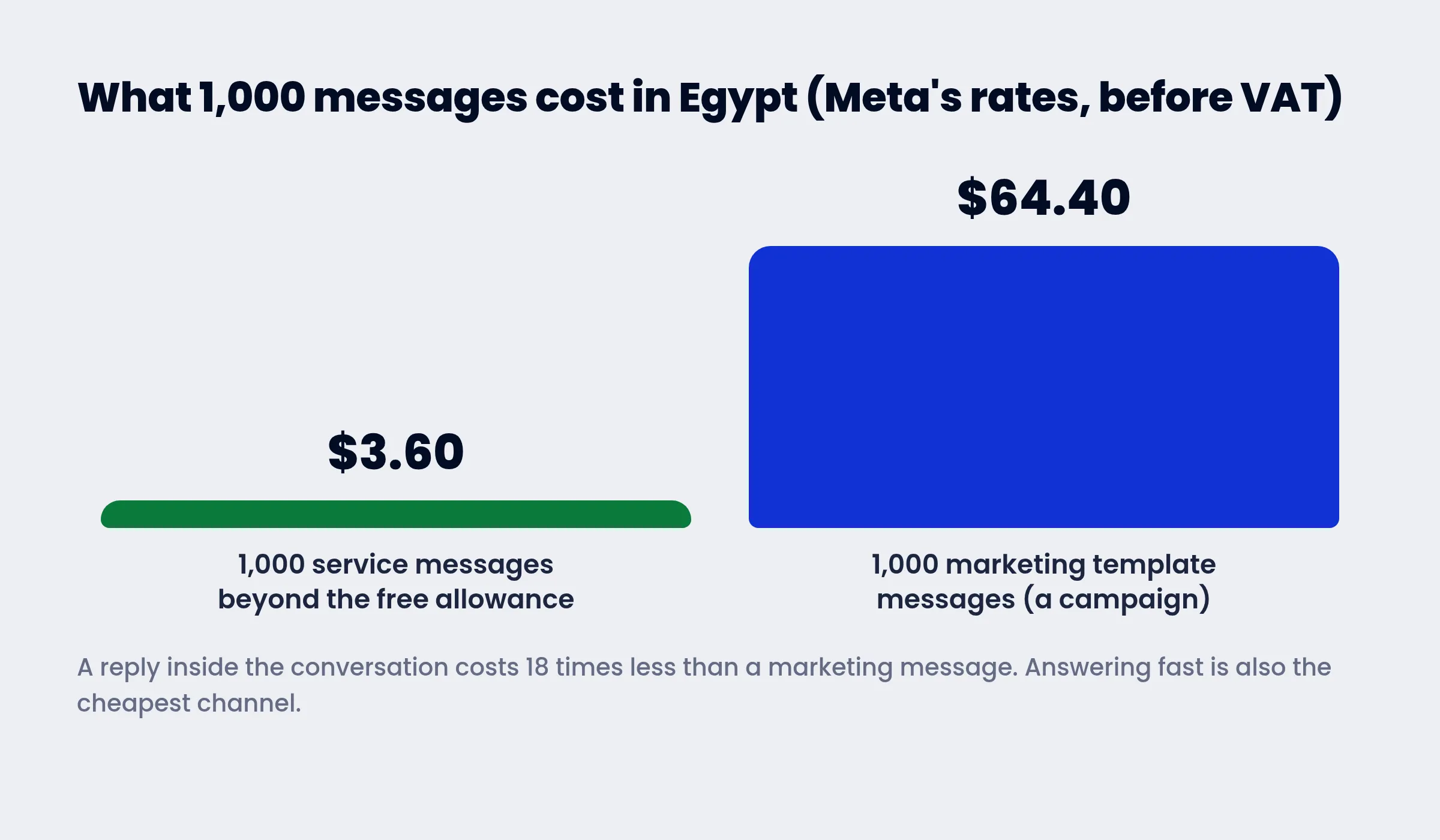
Put differently: a business that sends 3,000 service messages in a month — a busy support desk answering around a hundred chats a day — pays Meta about $7.20 plus VAT for the 2,000 beyond the allowance. The same 2,000 messages sent as a marketing campaign would cost $128.80. The reply inside the conversation is, by a wide margin, the cheapest message on WhatsApp.
Will you actually pay? What our clients' numbers say
We counted September 2026 — the last month before the change — across every business on ExceliaBOT, using the same rule Meta uses. The busiest number on the platform, a company that answers most of its customers through the assistant, sent 692 service messages. Everyone else was below 300. Not one account would have paid anything.
That matches what we see in most small and medium businesses in Egypt and the Gulf: a hundred to a few hundred real conversations a month, one or two replies each. The allowance is generous for them. It starts to matter for a support operation with several agents, a delivery business confirming every order in the chat, or an assistant that answers in three bubbles where one would do.
Five ways to keep the bill at zero
- One complete answer per reply. An assistant or an agent that sends "Hello!", then "Sure, let me check", then the actual answer has used three service messages to say one thing. Configure your assistant to answer in one message. (ExceliaBOT's assistant does.)
- Skip the filler. "Thank you for contacting us, an agent will reply shortly" is a message you pay for and the customer gains nothing from. Either answer, or say nothing until you can.
- Answer inside the window. When a customer writes, you have 24 hours to reply at $0.0036 or free. After the window closes the only way back is a template, at up to eighteen times the price. Fast replies are not only better service; they are the cheaper channel.
- Use the free ad window. A chat that starts from a click-to-WhatsApp ad is free for 72 hours, templates included. If you advertise, that is the moment to say everything you need to say.
- Watch the counter. You cannot manage what you cannot see. Your platform should show the running count for the month and warn you before you cross the line.
What ExceliaBOT does about it
Since 30 September the dashboard counts service messages the way Meta does: every free-form reply sent from the platform on WhatsApp, inside the window, calendar month, failed deliveries excluded. The Overview page shows the running total against the free 1,000, the meter turns amber at 90%, and the account owner receives one email that month at that point. We also keep Meta's own verdict on every message — the pricing object it reports on the delivery receipt — next to our count, so the two can be compared if an invoice ever looks off.
Nothing pauses when the allowance is used up. The assistant and your team keep replying; Meta simply bills what goes beyond, at its published rate, on your account. We add no margin, on service messages or on any other message — the pricing page says so in writing.
Sources: Meta's pricing page for the WhatsApp Business Platform; the October 2026 change as described by 360dialog and SendPulse. Rates are Meta's published rates for Egypt at the time of writing and may change.